Sunday, 30 October 2011

Myth of Hero and Leander


Hero and Leander were famous lovers in Greek mythology. Hero, who lived in the town of Sestos, served as a priestess of the goddess Aphrodite* (Venus). Leander was a youth from the nearby town of Abydos, located across a narrow strip of water called the Hellespont.
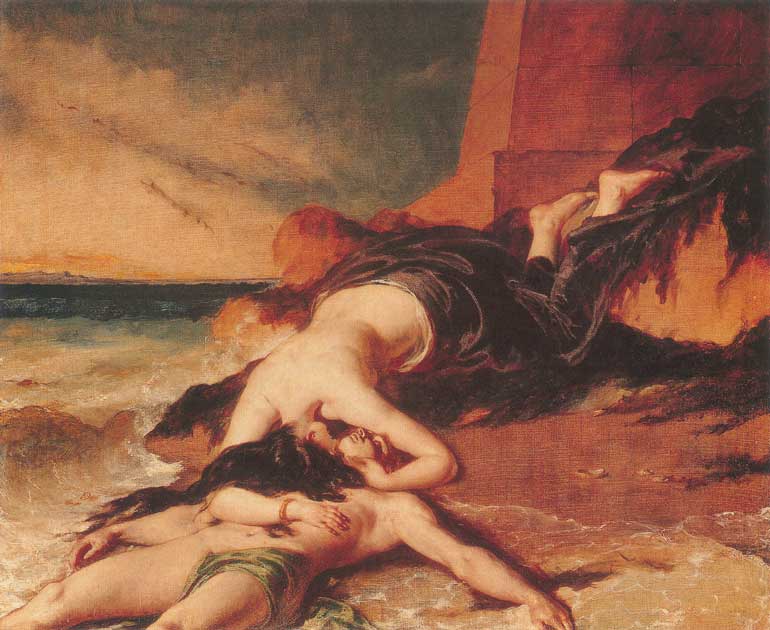
Hero and Leander met at a festival and fell in love. However, because she was a priestess of Aphrodite, Hero had to remain a virgin and was forbidden to marry. The two lovers decided to see each other secretly. Each night Hero would leave a lamp burning in a window of the tower in which she lived, and Leander would swim across the Hellespont, using the light to guide his way. One winter night, the wind blew out the flame in the lamp, causing Leander to lose his way and drown. The next morning, when Hero saw his lifeless body washed up on the shore, she killed herself by jumping out of the tower.
Several ancient poets, including Ovid* and Virgil*, told the tale of Hero and Leander. In 1598 the English author Christopher Marlowe used the story as the basis of his poem Hero and Leander. Lord Byron, John Keats, and Lord Tennyson were other well-known poets who wrote of the lovers. The tale also inspired paintings by Rubens, Turner, and Rossetti.

Bacchus - Roman God of Wine


Dionysus or Dionysos was the god of wine and inspired madness, and a major figure of Greek mythology. He represents not only the intoxicating power of wine, but also its social and beneficial influences. The geographical origins of his cult were unknown, but almost all myths depicted him as having "foreign" (i.e. non-Greek) origins.
He was also known as Bacchus and the frenzy he induces, bakcheia. He is the patron deity of agriculture and the theatre. He was also known as the Liberator (Eleutherios), freeing one from one's normal self, by madness, ecstasy, or wine. The divine mission of Dionysus was to mingle the music of the aulos and to bring an end to care and worry. Scholars have discussed Dionysus' relationship to the "cult of the souls" and his ability to preside over communication between the living and the dead.
In Greek mythology Dionysus is made to be a son of Zeus and Semele; other versions of the myth contend that he is a son of Zeus and Persephone. He is described as being womanly or "man-womanish". Dionysus had an unusual birth that evokes the difficulty in fitting him into the Olympian pantheon. His mother was Semele (daughter of Cadmus), a mortal woman, and his father Zeus, the king of the gods. Zeus's wife, Hera, a jealous and vain goddess, discovered the affair while Semele was pregnant. Appearing as an old crone, Hera befriended Semele, who confided in her that her husband was actually Zeus. Hera pretended not to believe her, and planted seeds of doubt in Semele's mind. Curious, Semele demanded of Zeus that he reveal himself in all his glory as proof of his godhood. Though Zeus begged her not to ask this, she persisted and he agreed. Mortals, however, cannot look upon a god without dying, and she perished. Zeus rescued the fetal Dionysus, however, by sewing him into his thigh.
A few months later, Dionysus was born.In another version of the same story, Dionysus was the son of Zeus and Persephone, the queen of the underworld. A jealous Hera again attempted to kill the child, this time by sending Titans to rip Dionysus to pieces after luring the baby with toys. Zeus drove the Titans away with his thunderbolts, but only after the Titans ate everything but the heart, which was saved, variously, by Athena, Rhea, or Demeter. Zeus used the heart to recreate Dionysus and implant him in the womb of Semele, hence he was again "the twice-born". Sometimes people said that he gave Semele the heart to eat to impregnate her.
The rebirth in both versions of the story is the primary reason he was worshipped in mystery religions, as his death and rebirth were events of mystical reverence. This narrative was apparently used in certain Greek and Roman mystery religions. Variants of it are found in Callimachus and Nonnus, who refer to this Dionysus under the title Zagreus, and also in several fragmentary poems attributed to Orpheus.
Childhood
The legend goes that Zeus took the infant Dionysus and gave him in charge to the rain-nymphs of Nysa, who nourished his infancy and childhood, and for their care Zeus rewarded them by placing them as the Hyades among the stars (see Hyades star cluster). Alternatively, he was raised by Maro.When Dionysus grew up he discovered the culture of the vine and the mode of extracting its precious juice; but Hera struck him with madness, and drove him forth a wanderer through various parts of the earth.
In Phrygia the goddess Cybele, better known to the Greeks as Rhea, cured him and taught him her religious rites, and he set out on a progress through Asia teaching the people the cultivation of the vine. The most famous part of his wanderings is his expedition to India, which is said to have lasted several years. Returning in triumph he undertook to introduce his worship into Greece, but was opposed by some princes who dreaded its introduction on account of the disorders and madness it brought with it.
As a young man, Dionysus was exceptionally attractive. Once, while disguised as a mortal on a ship, the sailors attempted to kidnap him for their sexual pleasures. Dionysus mercifully turned them into dolphins but saved the captain, Acoetes, who recognized the god and tried to stop his sailors.
Midas
Once, Dionysus found his old school master and foster father, Silenus, missing. The old man had been drinking, and had wandered away drunk, and was found by some peasants, who carried him to their king, Midas (alternatively, he passed out in Midas' rose garden). Midas recognized him, and treated him hospitably, entertaining him for ten days and nights with politeness, while Silenus entertained Midas and his friends with stories and songs. On the eleventh day he brought Silenus back to Dionysus. Dionysus offered Midas his choice of whatever reward he wanted.
Midas asked that whatever he might touch should be changed into gold. Dionysus consented, though was sorry that he had not made a better choice. Midas rejoiced in his new power, which he hastened to put to the test. He touched and turned to gold an oak twig and a stone. Overjoyed, as soon as he got home, he ordered the servants to set a feast on the table. Then he found that his bread, meat, daughter and wine turned to gold.
Upset, Midas strove to divest himself of his power (the Midas Touch); he hated the gift he had coveted. He prayed to Dionysus, begging to be delivered from starvation. Dionysus heard and consented; he told Midas to wash in the river Pactolus. He did so, and when he touched the waters the power passed into them, and the river sands changed into gold. (Note: this explained why the sands of the river Pactolus were rich in gold)
Other stories
When Hephaestus bound Hera to a magical chair, Dionysus got him drunk and brought him back to Olympus after he had passed out. For this act, he was made one of the twelve Olympians.Acis, a Sicilian youth, was sometimes said to be Bacchus' son.
A satyr named Ampelos was a good friend of Bacchus.Callirhoe was a Calydonian woman who scorned a priest of Dionysus who threatened to inflict all the women of Calydon with insanity. The priest was ordered to sacrifice Callirhoe but he killed himself instead. Callirhoe threw herself into a well which was later named after her.
As Dionysus was almost certainly a late addition to the pantheon of Greek mythology, there was some hostility to his worship. Homer mentions him only briefly and with much hostility. Euripides also wrote a tale concerning the destructive nature of Dionysus in his play entitled The Bacchae. Since Euripides wrote this play while in the court of King Archelaus of Macedon, some scholars believe that the cult of Dionysus was malicious in Macedon but benign in Athens. In the play, Dionysus returns to his birthplace, Thebes, ruled by his cousin, Pentheus.
Pentheus was angry at the women of Thebes, including his mother, Agave, for denying his divinity and worshipping Dionysus against his will. The worshippers of Dionysus were known as blood-thirsty, wild women called Maenads. The women tore Pentheus to shreds after he was lured to the woods by Dionysus. His body was mutilated by Agave.
When King Lycurgus of Thrace heard that Dionysus was in his kingdom, he imprisoned all the followers of Dionysus, the Maenads. Dionysus fled, taking refuge with Thetis. Dionysus then sent a drought and the people revolted. Dionysus made King Lycurgus insane, and he sliced his own son into pieces with an axe, thinking he was a patch of ivy, a plant holy to Dionysus.
An oracle then claimed that the land would stay dry and barren as long as Lycurgus was alive, so his people had him drawn and quartered. With Lycurgus dead, Dionysus lifted the curse.
Influence on Christianity
It is possible that Dionysian mythology would later find its way into Christianity. There are many parallels between the legends of Dionysus and Jesus; both were said to have been born from a mortal woman but fathered by a god, to have returned from the dead, and to have transformed water into wine. The modern scholar Barry Powell also argues that Christian notions of eating and drinking the flesh and blood of Jesus in order for individual followers to feel Jesus within them was influenced by the cult of Dionysus.
Certainly the Dionysus myth contains a great deal of cannibalism, in its links to Ino. Dionysus was also distinct among Greek gods, as a deity commonly felt within individual followers. In a less benign example of influence on Christianity, Dionysus' followers, as well as another god, Pan, are said to have had the most influence on the modern view of Satan as animal-like and horned. It is also possible these similarities between Christianity and Dionysiac religion are all only representations of the same common religious archetypes.
Furthermore, it is worth noting that the story of Jesus turning water into wine is only found in the Gospel of John, which differs on many points from the other Synoptic Gospels. That very passage, it has been suggested, was incorporated into the Gospel from an earlier source focusing on Jesus' miracles.
Dionysus in Neopaganism
Modern Neopagans view Dionysus in different lights, depending largely on the individual sects and the other gods worshipped by a sect. Dionysus is often seen as the god of Earthly Delights and is thought to play a role in euphoria. In the United States, some Hellenistic Neopagan sects forbid the worship of Dionysus, because Dionysus worship is associated with hedonism.
Sects which worship Hera and Themis in particular may forbid Dionysus worship. However, there are sects that make Dionysus a central figure of their faiths. Many sects may include both the worship of Themis and Dionysus, holding that moderation is key to virtue and that earthly delights are virtuous when maintaining responsibility and moderation. Depending on individual sects, and the other gods within the sect, worship of Dionysus can take many forms.
Sects that include worship of Themis and Hera for instance may allow the drinking of wine and various festivities, but actively discourage "decadence" and promiscuity.Those sects who worship Dionysus exclusively, or in more common cases Dionysus and Aphrodite, are sometimes known to conduct orgiastic rituals and use numerous intoxicants in attempts to reach earthly gratification and euphoria (Such sects are often considered cults even by Neopagan standards).
Most sects agree that it is unwise to trade future well being for a moment's pleasure. However, some followers of Dionysus believe that they are inspired to relish in earthly delights, ignoring any consequences

Myth of Dionysus


Greek Name
Transliteration
Latin Spelling
Roman Name

Διονυσος
Dionysos
Dionysus
Liber

Βακχος
Bakkhos
Bacchus
Bacchus
Dionysus, also commonly known by his Roman name Bacchus, appears to be a god who has two distinct origins. On the one hand, Dionysus was the god of wine, agriculture, and fertility of nature, who is also the patron god of the Greek stage. On the other hand, Dionysus also represents the outstanding features of mystery religions, such as those practiced at Eleusis: ecstasy, personal delivery from the daily world through physical or spiritual intoxication, and initiation into secret rites. Scholars have long suspected that the god known as Dionysus is in fact a fusion of a local Greek nature god, and another more potent god imported rather late in Greek pre-history from Phrygia (the central area of modern day Turkey) or Thrace.
According to one myth, Dionysus is the son of the god Zeus and the mortal woman, Semele (daughter of Cadmus of Thebes). Semele is killed by Zeus' lightning bolts while Dionysus is still in her womb. Dionysus is rescued and undergoes a second birth from Zeus after developing in his thigh. Zeus then gives the infant to some nymphs to be raised. In another version, one with more explicit religious overtones, Dionysus, also referred to as Zagreus in this account, is the son of Zeus and Persephone, Queen of the Underworld. Hera gets the Titans to lure the infant with toys, and then they rip him to shreds eating everything but Zagreus' heart, which is saved by either Athena, Rhea, or Demeter. Zeus remakes his son from the heart and implants him in Semele who bears a new Dionysus Zagreus. Hence, as in the earlier account, Dionysus is called "twice born." The latter account formed a part of the Orphic religion's religious mythology.
It does seem clear that Dionysus, at least the Phrygian Dionysus, was a late arrival in the Greek world and in Greek mythology. He is hardly mentioned at all in the Homeric epics, and when he is it is with some hostility. A number of his stories are tales of how Dionysus moved into a city, was resisted, and then destroyed those who opposed him. The most famous account of this is that of Euripides in his play the Bacchae. He wrote this play while in the court of King Archelaus of Macedon, and nowhere do we see Dionysus more destructive and his worship more dangerous than in this play. Scholars have speculated not unreasonably that in Macedon Euripides discovered a more extreme form of the religion of Dionysus being practiced than the more civil, quiet forms in Athens.
Briefly, Dionysus returns to Thebes, his putative birthplace, where his cousin Pentheus is king. He has returned to punish the women of Thebes for denying that he was a god and born of a god. Pentheus is enraged at the worship of Dionysus and forbids it, but he cannot stop the women, including his mother Agave, or even the elder statesmen of the kingdom from swarming to the wilds to join the Maenads (a term given to women under the ecstatic spell of Dionysus) in worship. Dionysus lures Pentheus to the wilds where he is killed by the Maenads and then mutilated by Agave.
A song sung in honor of Dionysus is called a dithyramb.

Friday, 14 October 2011

MYTH OF ACTÆON.


   It was midday, and the sun stood equally distant from either goal, when young Actæon, son of King Cadmus, thus addressed the youths who with him were hunting the stag in the mountains:—
      "Friends, our nets and our weapons are wet with the blood of our victims; we have had sport enough for one day, and to-morrow we can renew our labours. Now, while Phoebus parches the earth, let us put by our implements and indulge ourselves with rest."
      There was a valley thick enclosed with cypresses and pines, sacred to the huntress queen, Diana. In the extremity of the valley was a cave, not adorned with art, but nature had counterfeited art in its construction, for she had turned the arch of its roof with stones, as delicately fitted as if by the hand of man. A fountain burst out from one side, whose open basin was bounded by a grassy rim. Here the goddess of the woods used to come when weary with hunting and lave her virgin limbs in the sparkling water.
      One day, having repaired thither with her nymphs, she handed her javelin, her quiver, and her bow to one, her robe to another, while a third unbound the sandals from her feet. Then Crocale, the most skilful of them, arranged her hair, and Nephele, Hyale and the rest drew water in capacious urns. While the goddess was thus employed in the labors of the toilet, behold Actaeon, having quitted his companions, and rambling without any especial object, came to the place, led thither by his destiny. As he presented himself at the entrance of the cave, the nymphs, seeing a man, screamed and rushed towards the goddess to hide her with their bodies. But she was taller than the rest and overtopped them all by a head. Such a color as tinges the clouds at sunset or at dawn came over the countenance of Diana thus taken by surprise. Surrounded as she was by her nymphs, she yet turned half away, and sought with a sudden impulse for her arrows. As they were not at hand, she dashed the water into the face of the intruder, adding these words: "Now go and tell, if you can, that you have seen Diana unapparelled."  Immediately a pair of branching stag's horns grew out of his head, his neck gained in length, his ears grew sharp-pointed, his hands became feet, his arms long legs, his body was covered with a hairy spotted hide. Fear took the place of his former boldness, and the hero fled. He could not but admire his own speed; but when he saw his horns in the water, "Ah, wretched me!" he would have said, but no sound followed the effort. He groaned, and tears flowed down the face which had taken the place of his own. Yet his consciousness remained. What shall he do? — go home to seek the palace, or lie hid in the woods?  The latter he was afraid, the former he was ashamed to do. While he hesitated the dogs saw him. First Melampus, a Spartan dog, gave the signal with his bark, then Pamphagus, Dorceus, Lelaps, Theron, Nape, Tigris, and all the rest, rushed after him swifter than the wind. Over rocks cliffs, through mountain gorges that seemed impracticable, he fled and they followed. Where he had often chased the stag and cheered on his pack, his pack now chased him, cheered on by his huntsmen. He longed to cry out, "I am Actaeon; recognize your master!"  but the words came not at his will. The air resounded with the bark of the dogs. Presently one fastened on his back, another seized his shoulder. While they held their master, the rest of the pack came up and buried their teeth in his flesh. He groaned, — not in a human voice, yet certainly not in a stag's, — and falling on his knees, raised his eyes, and would have raised his arms in supplication, if he had had them. His friends and fellow-huntsmen cheered on the dogs, and looked everywhere for Actæon, calling on him to join the sport. At the sound of his name he turned his head, and heard them regret that he should be away. He earnestly wished he was. He would have been well pleased to see the exploits of his dogs, but to feel them was too much. They were all around him, rending and tearing; and it was not till they had torn his life out that the anger of Diana was satisfied.

One-Act Play


The One-Act Play, very popular in the 20th century, is regarded by many as a modern product. But this is far from the truth. One-Act Plays were written and staged throughout the 18th and the 19th centuries, as “The Curtain Raisers” or “The After Pieces”.
They were chiefly farcial and served to amuse the audience before the commencement of the actual drama or were staged for their amusement, just after it had come to an end. The famous One-Act Play “Monkey’s Paw” was first staged as a “Curtain Raiser” and it proved to be more entertaining than the main drama. It may be said to mark the beginning of the modern One-Act Play.
It was great Norwegian dramatist Ibsen that gave to the One-Act Play its modern touch. It was he, who, for the first time, introduced the minute stage-directions into the One-Act Play. Before him one act plays were written in poetry, but he made prose the medium of his one act plays. In short he made the drama, simple and real, and brought it nearer to everyday life. He made the modern One-Act Play what it is and his example has been widely followed.
George Bernard Shaw and John Galsworthy are two of his greatest followers. Bernard Shaw, a writer of international fame and the chief English dramatist of modern times, very closely follows the technique of Ibsen. His plays have long stage directions and are marked by a truly Ibsenian realism. The plays of Galsworthy, another dramatist of international fame, are also realistic and his characters are all of flesh and blood. His dramas have one idea and, consequently, one action which is sought to be illustrated through the interplay of circumstances on character or vice versa.
Owing to the influence of Ibsen the modern drama has come to have the following characteristics:
(a)      It depicts characters which are real and related to everyday life.
(b)      It treats of the problems of everyday life as marriage, punishment for crimes, labour conditions, divorce etc.
(c)       It introduces elaborate stage directions to minimise the time taken by the action itself.
(d)      It aims at simplicity of plot; concentration of action and unity of impression.
(e)      It does not reply on spectacular effects and common dramatic tricks of old.
(f)        It makes the dialogue more interesting than ever before.
(g)      Its language is simple and can be followed without any strain.
All these tendencies of the modern drama are suitably expressed through the One-Act play of to-day. In a way the modern One –Act play owes its growth to Ibsen. It is his technique which has made the One-Act play what it is, an important branch of literature and the most popular form of dramatic representation.
The One-Act Play also received impetus from the “Repertory Theatre Movement”. A Repertory Theatre is a theatre with a permanent company of actors who have a repertoire of plays to be performed by them. They do not give a large number of performances of any play but change their “bill” as often as two or three times a week. They do not function with a view to profit but to help the author and to recreate the artistic values. They therefore discard the “long run” system which may have financial advantages but is bad for both the actor and the dramatist. As the plays are chosen for their artistic value, the amateurs have a good chance as they do not care so much for financial advantages. As for art the amateurs were enthusiastic about the One-Act Play gained ground in spite of the opposition of the managers of Commercial Theatres.
The amateurs have done a great deal to popularise this dramatic form. It is short, requires no elaborate setting and costumes, and so comes in handy to be staged in amateur dramatic societies and clubs. It is the best training ground for the new aspirants to dramatic fame.
Chief Characteristics
The One Act play is often thought to be a short form of the long play. But the question is not one of length. A One-Act Play is a separate literary form by itself. It is not a condensed three or five Act Play, nor can it be elaborated into a three Act play. The very nature and structure of the two are entirely different. A One-Act Play deals with a single dominant situation, and aims at producing a single effect, though the methods used may vary greatly from tragedy to face, according to the nature of the effect desired. As the play is short and the action takes place within a short period of time, greatest economy and concentration is required. Everything superfluous is to be strictly avoided. The play must be close knit and the greatest attention must be paid to its structure. This makes the One-Act Play a difficult form of art and much training and practice is required to master it. It is a highly artistic form and has immense possibilities for development.
Though short in form the One-Act Play can have as its theme a large number of varied subjects. In fact every subject between heaven and earth is fit for the One-Act Play. It, of course, deals with only one action to produce the maximum of effect. Some tense situation or some particular phase in the life of an individual is chosen and is depicted in an effective manner. All attention is concentrated on that particular moment and the story of the play hangs on it.
Various problems connected with the life of the individual are discussed. Thus various sort of things – love, marriage, divorce, justice, crime, punishment, law, superstitions, customs and manners – are all suitable themes for a One-Act Play. According to its theme the One-Act Play can be divided into different types as – realistic plays, problem plays, phantasies, costume plays, satire, romance, etc. In short, the playwright has a large and varied choice of subjects which can be discussed equally well in the One-Act Play.
The One-Act Play, like the longer drama, should have a beginning, a middle and an end. It may be divided into four stages: The Exposition. The Conflict, The Climax and The Denouement. All these stages may be distinctly marked as in the larger play, but more often than not they tend to over-lap in a One-Act Play.
The Exposition serves as an introduction to the play. The situation and the themes of the play are explained to the audience and the important characters are also introduced. The part of the story that has already happened and which it is necessary to know for an understanding of the play, is also told to the audience. But as the One-Act Play is very short, the dramatist cannot devote much time to this introduction-and explanation. Hence the exposition of a One-Act Play is usually brief.
The exposition is followed by the conflict. It is through the conflict that the action of the drama develops. The conflict means a struggle between two opposing forces. The conflict may take different forms. There may be a struggle between two opposite interests, ideas, persons, group of persons, or the hero and his fate or circumstances. There may also be an inner conflict between two opposite ideas or urges in the mind of the hero, who may not be able to decide what to do and so may suffer great agony of spirit as a consequence. The conflict is the very back-bone of the One-Act Play. Complications after complications arise and the readers are in constant suspense about the outcome of the conflict.
After the conflict comes the climax. It is the turning point of the drama. One of the two contending forces now gains supremacy over the others. It is now clear which of the two would win in the end. The climax is an important part of the One-Act Play and constitutes its moment of supreme interest.
The Denouement is the next and the final stage of the One-Act Play. The play now reaches its end. One of the two contending forces now definitely gets victory over the other and the action of the drama concludes. As the space at the disposal of the writer of One-Act Plays is limited, the denouement is very brief and often overlaps with climax. The plays come to an end just after the climax.
There are three dramatic unities which are observed in the One-Act Play as far as possible. The unities are – the unity of time, unity of place and the unity of action. If the drama is to be probable and natural, these three unities are to be observed by the dramatist. Of course, sometimes it is difficult to observe these unities, but effort is to be made to observe them as far as possible.
The characters in a One-Act Play are limited in number. The space at the disposal of the playwright is limited and if he introduces too many characters, it would result in overcrowding and lessen the effect of the drama. Of course, there is no hard and fast rule as to the number of characters in a play. But generally there are not more than two or three principal characters.
Not only are the characters limited in number, there is also no full development of character. The dramastist has no time to present the characters through the different stages of their development. All the different aspects of a character are not presented. The attention is focused on only one or two salient aspects of character and they are brought out by placing the characters in different situations and circumstances.
Besides this, the characters in the modern One-Act Play are ordinary men and women. They are neither saints nor devlis. They have all the faults and weaknesses, as well as all the virtues that ordinary human beings have. If they are otherwise, it would make the play unnatural, unrealistic and unconvincing.
Dialogue is of the greatest importance in the One-Act Play. As the drama is short, all superfluity is to be avoided. Absolute economy of means should be used. Every word is to be carefully choosen and sentences must be compact and condensed. Effort should be made to say, whatever is to be said, in the least possible words. Thus the language of the dialogue should be simple, brief and easy to understand. Long speeches and arguments and long sentences would be out of place and would lessen the charm and interest of the play.
Detailed stage-directions are invariably introduced by the dramatist in the One-Act Play. The space at the disposal of the playwright is limited and so he cannot supply us detailed information through a lengthy exposition or during the action of the play itself. This purpose is served by the stage directions. Moreover these stage directions, describing the minute details of the scene, give an air of realism to the drama.
Besides, the play is not meant only for acting but for reading as well. The reader can know of the entire scene through the stage direction and can, to a great extent, appreciate the real spirit of the drama. These stage directions make the play perfectly clear to the reader. They impart realism and verisimilitude to the One-Act Play.
Thursday, 13 October 2011

The Role Of Puck in A Midsummer Night's Dream


        The role and character of Puck, or Robin Goodfellow, in A Midsummer Night's Dream, is not only entertaining but quite useful.

        William Shakespeare seems to have created the character of Puck from his own childhood.  In Shakespeare's  time it was believed that fairies and little people did exist.  Whenever something went wrong around the farmyard or house or village, incidents such as buckets of milk ‘accidentally' spilling over, or tools suddenly disappearing, or doors opening for no reason,  it was blamed on ‘
those damn little people!'.
   The idea of Puck's character is a lovely one.  One can't help but be attracted to him and his innocent, little pranks.   He is also known by the name Robin Goodfellow.  The audience can only see this ‘Robin Goodfellow' side of Puck when he is trying to fix something he disrupted, hence the name Goodfellow.

    When compared to Oberon, King of the Fairies and Titania, Queen of the Fairies and the remaining fairies of the play, Puck does not seem to fit in as well.  While Oberon and Titania belong to the forest and the world of dainty fairies, a small village setting seems more appropriate for Puck.  He is the type of fairy that likes to be around mortals and cause them trouble, as opposed to other fairies.  This is why Puck's  little job with a love potion and a young
couple is perfect for him and he perfect for the job. Puck is a likable character who tends to create mischief around himself.

Everything is a game to crafty little Puck.   Yet once he realizes that he has caused a problem he will make sure to the best of his ability and power that it is rectified.  As in the scene with Hermia and Lysander, and Helena and Demetrius.  When Puck mistook Lysander for Demetrius (Shakespeare conveniently had the characters look alike or ‘only slightly individualized') and dropped the love-juice into Lysander's eyes and then (with help from Oberon) realized what he had done he knew he had to fix it.


        Shakespeare conveniently created ‘Puck' to add some probability to the play.  Since the typical audience believed in fairies and little people, Puck could be convincing in his role.  It is possibly,  even today, more plausible to have a little fairy running around causing problems than to have to try and believe that fate and destiny were the cause of all the joy, sadness and badluck.

   When William Shakespeare created ‘Puck' it seems as though the play got much more out of the character than intended.  This is nice however,  as the audience we tend to like Puck and follow him in a light-hearted, amused  manner.

The character of Puck keeps the play rolling and everything turns out well in the end, unlike many other plays of Shakespeare.

Rules of Word Stress in English


There are two very simple rules about word stress:
1.    One word has only one stress. (One word cannot have two stresses. If you hear two stresses, you hear two words. Two stresses cannot be one word. It is true that there can be a "secondary" stress in some words. But a secondary stress is much smaller than the main [primary] stress, and is only used in long words.)
2.    We can only stress vowels, not consonants.

Here are some more, rather complicated, rules that can help you understand where to put the stress. But do not rely on them too much, because there are many exceptions. It is better to try to "feel" the music of the language and to add the stress naturally.
1 Stress on first syllable
rule
example
Most 2-syllable nouns
PRESent, EXport, CHIna, TAble
Most 2-syllable adjectives
PRESent, SLENder, CLEVer, HAPpy
2 Stress on last syllable
rule
example
Most 2-syllable verbs
to preSENT, to exPORT, to deCIDE, to beGIN
There are many two-syllable words in English whose meaning and class change with a change in stress. The word present, for example is a two-syllable word. If we stress the first syllable, it is a noun (gift) or an adjective (opposite of absent). But if we stress the second syllable, it becomes a verb (to offer). More examples: the words export, import, contract and object can all be nouns or verbs depending on whether the stress is on the first or second syllable.
3 Stress on penultimate syllable (penultimate = second from end)
rule
example
Words ending in -ic
GRAPHic, geoGRAPHic, geoLOGic
Words ending in -sion and -tion
teleVIsion, reveLAtion
For a few words, native English speakers don't always "agree" on where to put the stress. For example, some people say teleVIsion and others say TELevision. Another example is: CONtroversy and conTROversy.
4 Stress on ante-penultimate syllable (ante-penultimate = third from end)
rule
example
Words ending in -cy, -ty, -phy and -gy
deMOcracy, dependaBIlity, phoTOgraphy, geOLogy
Words ending in -al
CRItical, geoLOGical
5 Compound words (words with two parts)
rule
example
For compound nouns, the stress is on the first part
BLACKbird, GREENhouse
For compound adjectives, the stress is on the second part
bad-TEMpered, old-FASHioned
For compound verbs, the stress is on the second part
to underSTAND, to overFLOW

 ADVANCED STUDY ON MODIFIERS In advanced English grammar, modifiers transition from simple descriptive words ( the blue sky ) to complex st...